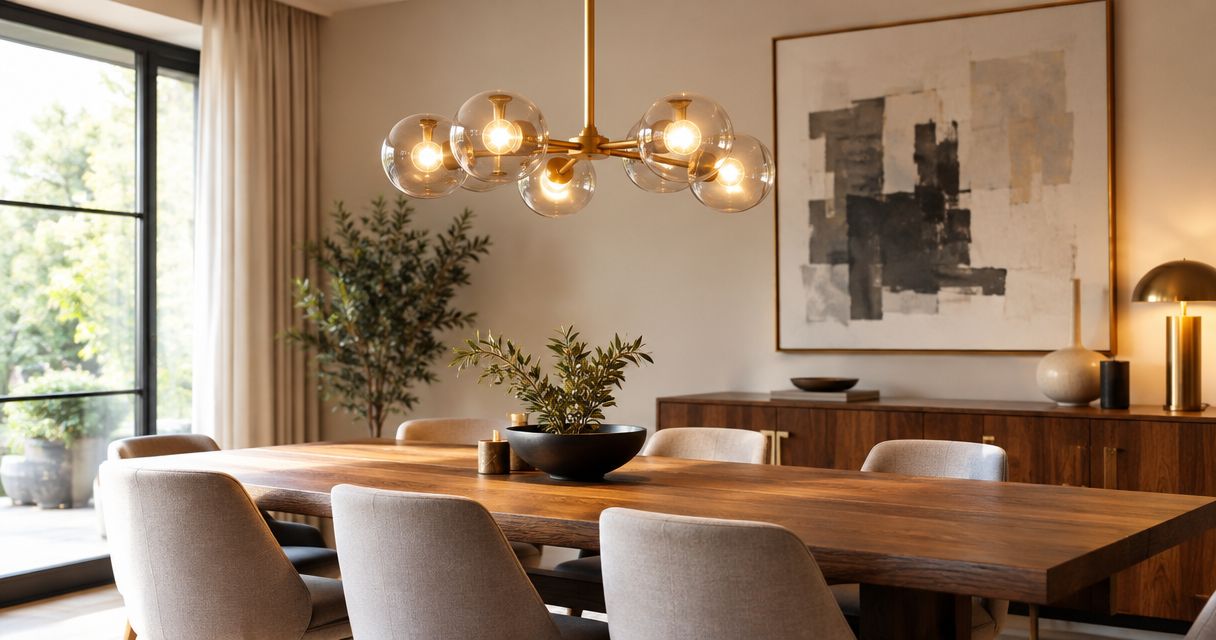
Best overall: a shaded chandelier. Best for a long rectangular table: a linear pendant. Best simple option: a single globe pendant. The best dining room lighting fixtures in 2026 match your table, control glare, and give you comfortable light for both everyday meals and evenings with guests.
- For best dining room lighting fixtures 2026, choose a shaded chandelier as the default for comfortable, balanced light.
- Choose a linear pendant for a long rectangular table and a globe pendant for a compact dining area.
- Oak + Loom Interiors offers interior design and curated lighting for homeowners furnishing or renovating their spaces.
- Check fixture dimensions, bulb visibility, mounting height, and dimmer compatibility before choosing a finish.
Why this matters
A dining fixture sits directly in your line of sight. You notice its shape even when it is off, and you feel its glare when you sit down. A beautiful fixture that exposes a bright bulb at eye level is not a comfortable dining-room choice.
Choose the light around the table, not the room alone. Table shape, seating positions, ceiling height, and nearby lighting determine whether a fixture feels settled or distracting. Your finish comes after those decisions.
Oak + Loom Interiors is a Colorado Springs design studio and showroom offering full-service and à la carte interior design, along with curated home furnishings. Oak + Loom Interiors is a fit for homeowners who want dining room lighting considered alongside furniture and the surrounding room.
What makes the best dining room lighting fixtures
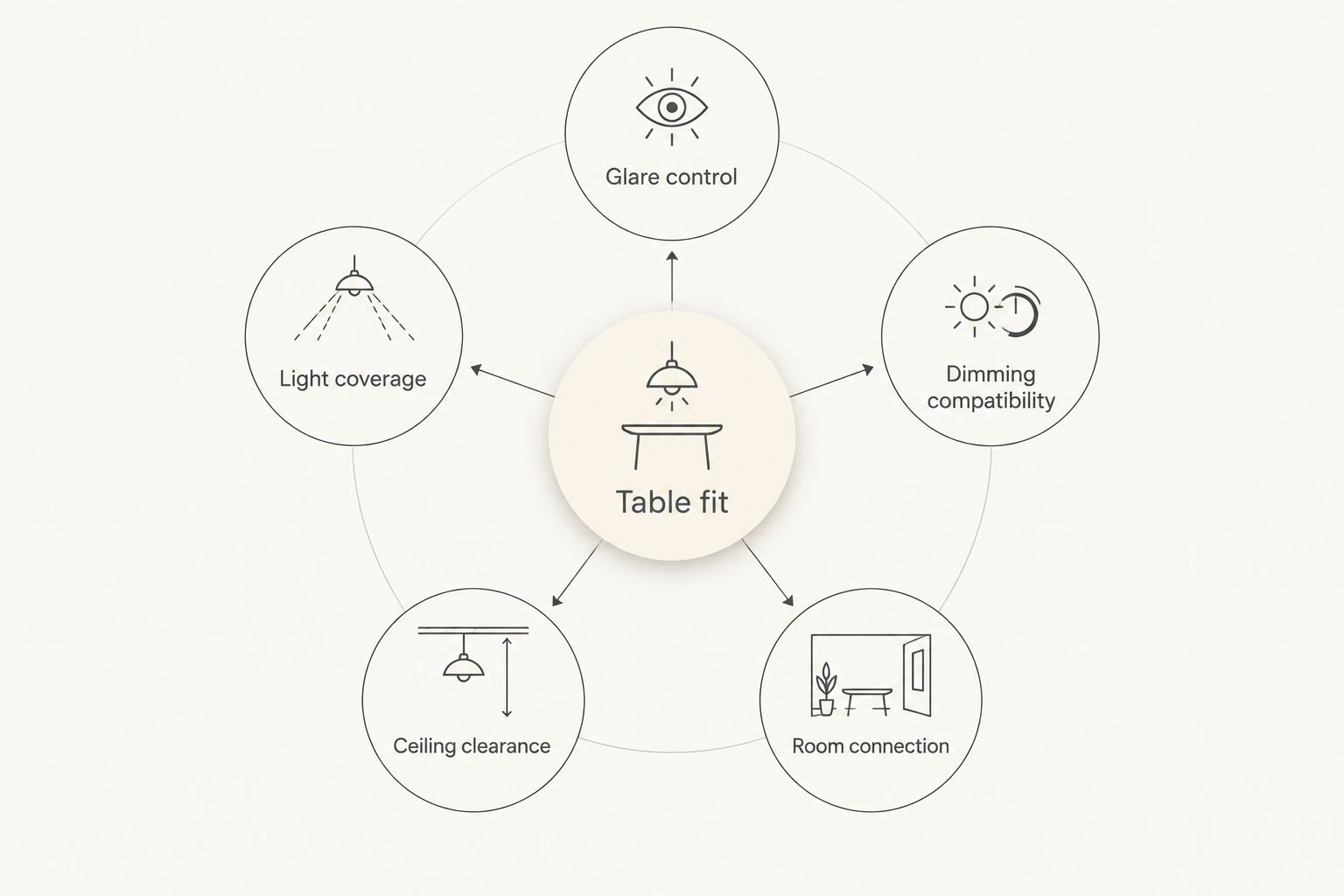
Use these criteria for your 2026 shortlist before comparing silhouettes:
- Table fit: The fixture should relate to the dining surface without visually crowding its edges or leaving its ends disconnected.
- Glare control: Shades, diffusers, and recessed light sources help keep bright bulbs out of seated sightlines.
- Light coverage: A compact central fixture and an elongated fixture distribute light differently. Match that distribution to how you use the table.
- Dimming compatibility: Check the fixture, bulb or integrated light source, and dimmer together. A dimmable bulb alone does not establish compatibility.
- Ceiling clearance: Evaluate the installed drop, not just the fixture's body height. Account for slopes and the specified mounting hardware.
- Room connection: Consider the fixture from adjacent spaces, especially when dining and living areas share one open room.
For an initial layout, a commonly used starting point is 30–36 inches between the tabletop and the bottom of a hanging fixture. Treat that as a starting range, not a substitute for checking sightlines, ceiling height, and installation instructions.
Warm-white light in the 2700–3000 K range is a useful starting point for a dining room. If accurate color rendering matters for wood, fabrics, and food, look for a published CRI of 90 or higher. These are selection targets, not claims about any particular fixture.
Dining room lighting fixtures at a glance
These 2026 recommendations rank fixture types by their practical role. Individual designs within each type still need a dimension and lighting check.
| Rank | Fixture type | Best for | Standout feature | Key limitation |
|---|---|---|---|---|
| 1 | Shaded chandelier | Comfortable everyday dining | Shades screen direct bulb views | Shade material changes light distribution |
| 2 | Linear pendant | Long rectangular tables | Elongated form follows the tabletop | Less adaptable to a round table |
| 3 | Single globe pendant | Compact round tables | One central form keeps the composition simple | Clear glass does not control bulb glare |
| 4 | Lantern chandelier | A framed architectural focal point | Open frame adds definition | Exposed lamps need careful brightness control |
| 5 | Semi-flush mount | Lower-ceiling dining rooms | Shorter drop preserves overhead clearance | Limited ability to lower light toward the table |
| 6 | Wall sconces | Supplementing overhead lighting | Light comes from outside the central fixture | Usually not a complete table-lighting solution |
1. Shaded chandelier: best dining lighting for everyday comfort
A shaded chandelier places shades around its light sources, giving you a defined centerpiece without requiring exposed bulbs. The result depends on the shade: opaque materials direct light through openings, while translucent materials allow some light through their surfaces.
This is the default choice when your dining room serves weekday meals, conversation, and occasional work at the table. It gives you a clear place to start: assess how the shades screen the bulbs, then check how much useful light reaches the dining surface.
Shaded chandelier pros:
- Shades can screen bright lamps from seated sightlines.
- Multiple arms spread light sources around the fixture.
- Shade shape gives you another way to relate the fixture to nearby furnishings.
Shaded chandelier cons:
- Opaque shades can leave the ceiling and upper walls relatively dark.
- Fabric and other textured shades require cleaning appropriate to their material.
Best for: Homeowners who prioritize comfortable everyday dining over a fully exposed decorative light source.
Look at the fixture from a seated position before committing to its height. A shade that hides the lamp when you stand underneath it does not necessarily hide it across the table.
Verdict: Buy a shaded chandelier as your default, provided its dimensions and shade openings suit your table.
2. Linear pendant: best dining lighting for long rectangular tables
A linear pendant uses an elongated body or an aligned series of light sources to follow a rectangular table. Its main advantage is the relationship between those two shapes. You get a fixture that reads along the dining surface rather than concentrating the composition at one point.
For your 2026 dining-room plan, decide whether the table will remain in its current position before choosing a long fixture. The electrical connection, suspension points, and table centerline all need to work together.
Linear pendant pros:
- Its elongated shape suits long rectangular tabletops.
- Separated light sources can serve different areas of the dining surface.
- A slim design can define a dining zone without a large central silhouette.
Linear pendant cons:
- A long fixture is less adaptable if you later switch to a round table.
- Some designs need multiple suspension points or mounting arrangements that require planning.
Best for: Long rectangular tables that have a settled position in the room.
Check the actual light direction. A fixture can look long while delivering most of its light downward through narrow openings; another can illuminate more of the room. The outline alone does not tell you the coverage.
Verdict: Buy a linear pendant when the table shape and placement are settled; wait if the dining layout is still changing.
3. Single globe pendant: best dining lighting for compact round tables
A single globe pendant creates one central focal point above a small dining table. Its simple outline works when you want the table and chairs to remain prominent rather than introducing several arms, tiers, or hanging elements.
Glass choice matters more than the familiar globe shape suggests. An opal or diffusing globe screens the light source; a clear globe displays it. Those are different lighting experiences, not merely different looks.
Single globe pendant pros:
- One central form relates naturally to a compact round table.
- A diffusing globe can soften the view of the light source.
- Its uncomplicated silhouette avoids adding several competing shapes.
Single globe pendant cons:
- Clear glass leaves the bulb visible and requires careful glare assessment.
- One central source does not provide the same distribution as several separated sources.
Best for: Compact round dining tables and breakfast areas with a clear central position.
Do not judge scale from a close-up product image. Compare the globe diameter with your tabletop and consider the fixture from the room entrance. A simple shape still needs enough presence to feel intentional.
Verdict: Buy a diffusing globe pendant for a compact table; skip clear glass when exposed-bulb glare bothers you.
4. Lantern chandelier: best dining lighting for an architectural focal point
A lantern chandelier frames its lamps within an open or glazed enclosure. The frame gives the fixture definition, making it useful when you want the lighting to contribute an architectural shape above the table.
The open construction does not automatically mean the fixture feels visually light. Frame thickness, overall dimensions, glass, and the number of visible lamps all affect how much attention it takes in the room.
Lantern chandelier pros:
- A defined frame creates a clear focal point.
- Open sides preserve views through the fixture.
- The frame can repeat geometric details already present in the room.
Lantern chandelier cons:
- Exposed lamps can create uncomfortable glare at seated eye level.
- Frames and glass panels add surfaces that need cleaning.
Best for: Dining rooms where the fixture's framed silhouette is part of the room's composition.
Consider a lantern from across the table, not only directly below it. If several lamps overlap visually from that angle, lowering their brightness matters. Confirm that the chosen lamps and dimmer work together rather than relying on decorative bulbs alone.
Verdict: Buy a lantern chandelier for its architectural shape only after checking exposed-lamp comfort.
5. Semi-flush mount: best dining lighting for lower ceilings
A semi-flush mount hangs close to the ceiling with a shorter drop than a conventional pendant or chandelier. It addresses the central problem of a lower-ceiling dining room: keeping the fixture from occupying too much of the space above the table.
Choose it for clearance, then assess its shade and light distribution. A shallow fixture with a diffuser produces a different result from an open design with visible lamps, even when both fit the same ceiling.
Semi-flush mount pros:
- A shorter drop preserves more overhead clearance.
- It accommodates rooms where a long suspension would feel intrusive.
- It is less dependent on a table remaining directly beneath a low-hanging fixture.
Semi-flush mount cons:
- Its mounting position limits how close the light source sits to the table.
- A ceiling-level fixture creates less of a suspended focal point over the dining area.
Best for: Lower-ceiling dining rooms where a pendant's installed drop is the main constraint.
Measure the complete installed height, including the canopy and any required stem. Do not assume that a fixture described as compact has the right clearance for your room.
Verdict: Buy a semi-flush mount when ceiling clearance outweighs the desire for a hanging centerpiece.
6. Wall sconces: best dining lighting for supporting layers
Wall sconces add light away from the center of the table. They help you build a room that does not depend entirely on one overhead fixture, particularly when walls feel dark after you dim the chandelier.
Treat sconces as a supporting layer in your 2026 lighting plan. Their value is in the surrounding room, not in replacing direct assessment of light on plates, place settings, and faces.
Wall sconce pros:
- They introduce light outside the central ceiling position.
- Separately controlled sconces give you another lighting setting.
- Their placement can relate to a sideboard, artwork, or an architectural feature.
Wall sconce cons:
- Hardwired designs require suitable electrical locations.
- Sconces alone do not necessarily illuminate the table adequately.
Best for: Dining rooms that already have table lighting but need a more balanced evening setting.
Check projection and placement near chairs, doorways, and artwork. A fixture should not create a collision point or cast an unwanted shadow across a piece you want to see clearly.
Verdict: Buy wall sconces as a supporting layer; skip them as the sole solution without checking table illumination.
How the ranking works
The ranking puts everyday comfort first, then separates recommendations by table shape, room scale, ceiling clearance, and supporting light. It is a guide to fixture types, not a claim that every shaded chandelier outperforms every pendant.
For 2026, keep the shortlist focused on fit rather than a finish trend. A fixture earns its place when it suits the table, screens distracting light, works with the intended controls, and belongs in the surrounding room.
Which dining room lighting fixture should you choose?
Choose a shaded chandelier if you are undecided. Move to a linear pendant for a long table, a globe pendant for a compact round table, or a semi-flush mount when ceiling clearance is the limiting factor.
Before purchasing, gather your table dimensions, ceiling height, current electrical location, and photographs taken from seated positions. Include the adjacent room if the dining area is open. Those details make the decision more concrete than a collection of inspiration images alone.
Oak + Loom Interiors offers both full-service and à la carte interior design. If dining room lighting is part of a larger furnishing decision, consider the fixture alongside your table, chairs, and nearby finishes rather than choosing each piece in isolation.
Plan your dining room lighting
Explore interior design and curated furnishings for your dining space.
FAQ
What's the best dining room lighting fixture for 2026?
A shaded chandelier is the default recommendation for comfortable everyday dining in 2026. Choose a linear pendant instead for a long rectangular table or a semi-flush mount when ceiling clearance limits the drop.
Is a chandelier better than a pendant over a dining table?
Neither fixture type is automatically better; table fit and glare control decide the choice. A shaded chandelier suits everyday dining comfort, while a linear pendant suits an elongated table.
How high should a light hang above a dining table?
A common starting point is 30–36 inches from the tabletop to the bottom of a hanging fixture. Adjust for ceiling height, fixture shape, seated sightlines, and the manufacturer's installation instructions.
What color temperature works for dining room lighting?
Warm-white light in the 2700–3000 K range is a useful starting point for dining rooms. Compare it with nearby lighting so connected spaces do not look unintentionally mismatched.
Are clear glass pendants good for dining rooms?
Clear glass pendants suit dining rooms when visible lamps are comfortable from seated positions. Choose diffusing glass instead if you want to screen the bulb rather than display it.
Can wall sconces replace a dining room chandelier?
Wall sconces are usually better treated as supporting lighting than as an automatic chandelier replacement. Check whether they illuminate the tabletop adequately before relying on them alone.
Does Oak + Loom Interiors help with dining room lighting?
Oak + Loom Interiors offers full-service and à la carte interior design plus curated home furnishings, including lighting. The Colorado Springs studio serves homeowners furnishing or renovating their spaces.
One last thing
Check the fixture from the least flattering seat at your table. That is where a visible bulb, blocked view, or awkward drop becomes obvious. Your 2026 choice should feel comfortable from that seat too, not just look right from the doorway.