
Yes—an interior designer can work with furniture you already own, using pieces you want to keep as the starting point for a room rather than replacing everything. For a 2026 room refresh, confirm that existing-furniture planning is included in the designer’s scope, and expect an honest conversation about condition, comfort, scale, and what belongs where.
- Can an interior designer work with my existing furniture? Yes—confirm that furniture reuse is included in the project scope.
- Keep meaningful furniture, but test its placement before choosing new pieces around it.
- Oak + Loom Interiors offers full-service and à la carte interior design for Colorado Springs homeowners.
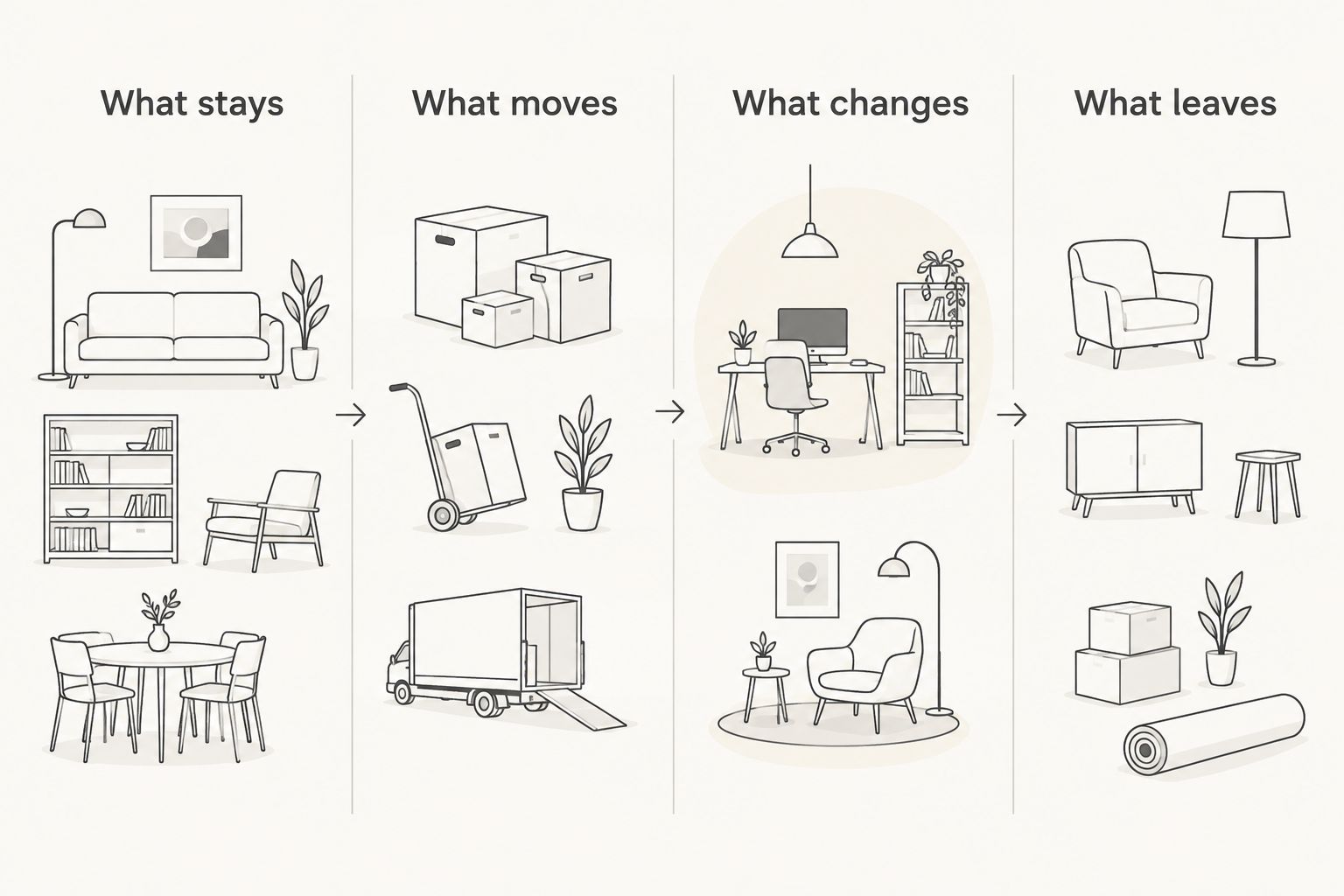
- An existing-furniture plan should distinguish what stays, what moves, what changes, and what leaves.
Can an interior designer work with furniture I already own?
Yes. Designing around existing furniture means treating your belongings as part of the design brief, not as obstacles to a finished room. The useful question is not whether everything matches; it is whether each piece supports the way you want the room to feel and function.
A practical starting sequence is:
- Name the nonnegotiables. Identify furniture you intend to keep, including pieces with sentimental value.
- Document the furniture. Gather photographs, dimensions, and notes about condition or comfort.
- Test the layout. Establish where the retained pieces fit before selecting additions.
- Define the remaining work. Separate rearranging from repairs, new furnishings, and changes to finishes or lighting.
Oak + Loom Interiors offers full-service and à la carte interior design alongside curated home furnishings in Colorado Springs. When discussing a project, make your wish to retain furniture part of the opening brief—not something introduced after selections have begun.
Why this matters
You do not need to discard a dining table you love simply because you want a different room. Equally, keeping something does not require leaving it in its current position, surrounded by the same pieces.
The goal is a room that works with your furniture, not a room that works around its problems. That distinction gives you permission to keep meaningful belongings while questioning arrangements that no longer serve you.
An existing sofa, for example, establishes a physical footprint and a seating experience. Its upholstery also becomes part of the color and texture decisions. Resolve those relationships before choosing a rug or another chair, so each addition answers a specific need rather than creating another decision.
Keep, relocate, refresh, or replace?
Give each piece a proposed role before you decide what to buy. These are planning options, not automatic recommendations: a piece can be worth keeping emotionally while needing a different place physically.
| Decision | Best for | Advantage | Limitation |
|---|---|---|---|
| Keep | Furniture that fits, functions, and matters to you | Preserves a useful piece and gives the room a starting point | Its dimensions and appearance remain design constraints |
| Relocate | Useful furniture that feels wrong in its current room | Gives an existing piece a different purpose | The receiving room must have a genuine need and enough space |
| Refresh | Furniture you want to retain with a change to its finish or upholstery | Lets you reconsider appearance without replacing the whole piece | Suitability depends on construction, condition, and the proposed work |
| Replace | Furniture that no longer meets your needs | Removes a limitation the room cannot otherwise resolve | Means letting go of the original piece and selecting something else |
Avoid deciding from a photograph alone. A chair can look right but feel uncomfortable; a cabinet can be attractive but prevent a door from opening fully. Bring those everyday frustrations into the discussion.
Keeping furniture does not mean keeping the arrangement
A familiar layout can make a room’s limitations feel permanent. Before blaming the furniture, test whether changing its position improves the relationship between seating, storage, windows, and doorways.
For a more detailed starting point, use this floor plan to furniture layout workflow. The important sequence is to understand the room first, place the furniture second, and choose additions afterward.
What kind of design help should you ask for?
Ask for the level of involvement you need, not simply a service label. Full-service and à la carte offerings describe different ways to engage a designer, but the written scope determines which tasks belong to the project.
Oak + Loom Interiors is best for Colorado Springs homeowners seeking interior design support and curated home furnishings. Its full-service and à la carte offerings provide a starting point for discussing how much help your project requires; confirm the specific work before committing.
| Approach | Best for | What to establish | Trade-off |
|---|---|---|---|
| À la carte interior design | A defined problem or limited set of decisions | Whether the scope addresses your layout, retained furniture, or other requested decisions | Work outside that scope remains your responsibility unless separately included |
| Full-service interior design | A broader furnishing or renovation project | Which planning, selection, and implementation tasks are included | A broader engagement needs a clearly defined brief and responsibilities |
For a 2026 project centered on furniture you already own, state the desired outcome plainly: a workable layout, a coordinated room, or help completing an unfinished space. Ask the studio which service scope addresses that outcome.
Neither approach automatically means repairs, reupholstery, moving, or installation are included. Treat those as separate scope questions rather than assumptions about what an interior designer does.
How to prepare your existing furniture for a design conversation
You do not need a polished presentation. You need enough information to show what you own, what you value, and what is not working.
Start with an inventory
Make a room-by-room list and mark each item as must keep, open to change, or undecided. Include furniture stored elsewhere if you genuinely want to use it in the project.
Explain the reason behind each must-keep piece. An inherited cabinet, a comfortable reading chair, and a table that accommodates family gatherings represent different needs. A designer needs that distinction to understand which aspects are negotiable.
Do not describe everything as essential just to avoid making an early decision. An undecided category keeps the conversation open without committing you to removal.
Record dimensions and condition
Record 3 dimensions for each substantial piece: width, depth, and height. Note projecting handles, arms, or other details that affect its footprint, rather than relying on a visual estimate.
Photograph the whole piece and any damage or wear relevant to the discussion. Add a short note about how it feels in use: comfortable, difficult to move, awkward to access, or no longer suited to its purpose.
Measure the room and identify doors, windows, and fixed features as well. Furniture dimensions alone cannot establish whether an arrangement works; the room supplies the other half of the information.
Explain how you use the room
Describe a normal day in the space. Where do you sit, read, work, eat, or gather? Which routes do you use, and what do you find yourself moving out of the way?
Separate a practical need from an appearance preference. Wanting somewhere to put a reading lamp is a different problem from disliking the current side table, even when both concerns involve the same corner.
Be equally clear about what already works. Good planning should preserve a comfortable routine rather than change it merely to make the room look different.
Set priorities before selecting additions
For your 2026 planning notes, use 4 decisions: what stays, what moves, what changes, and what leaves. Give uncertain pieces a temporary category rather than treating every decision as final.
Then write down the gaps. You might need a usable surface beside a chair, more suitable lighting, or a place for everyday belongings. Describe the function before naming the item you think will solve it.
Choose new furniture to complete the plan, not to postpone the plan. A missing function provides a clearer reason for a purchase than an empty corner does.
Once those decisions are recorded, bring the information into a scope conversation. You can ask for help without having settled every question yourself.
Explore help for your home
Discuss full-service or à la carte interior design for your furnishing or renovation project.
Why designing around existing furniture varies
The same request—keep my furniture—can involve very different work. Use these factors to explain your project clearly rather than treating furniture reuse as a single task.
- Amount of change. Rearranging a furnished room is different from retaining a sofa while reconsidering everything around it. State which decisions are open.
- Condition. A piece that needs repair introduces a separate assessment from choosing its location or surrounding colors.
- Room fit. Furniture must relate to doorways, fixed features, other pieces, and the routes you use through the room.
- Daily use. A decorative chair and your main reading chair have different jobs. Appearance alone cannot establish whether either serves its purpose.
- Personal priorities. Sentimental value can make retaining a piece the right decision even when it creates additional design constraints.
- Project boundaries. A furniture-only refresh differs from a renovation that also changes finishes, lighting, or the room itself.
In a 2026 project brief, distinguish must retain this piece from must retain this arrangement. Those statements give a designer very different problems to solve.
Can I mix old furniture with new furniture?
Yes—old and new furniture can share a room without matching as a set. Start by deciding which existing piece leads the room, then consider how new additions relate to its scale, color, material, and purpose.
For example, a substantial wood table does not require every surrounding piece to repeat the same finish. Look for a deliberate relationship rather than identical surfaces, and review material samples together before making decisions.
The limitation is that every addition still has to fit physically. A coordinated color palette cannot correct a chair that prevents comfortable movement around the table.
Do I have to keep every piece I inherited?
No—you can value an inherited piece without giving it a permanent place in your main living room. Decide whether your attachment is to using it, seeing it daily, or preserving it for personal reasons.
Explain that distinction before asking for a layout. Keeping a cabinet in another suitable room is a different brief from making it the focal point of the space you are redesigning.
Avoid changing a sentimental piece simply because an alteration seems visually convenient. Decide what you want preserved before discussing refinishing or upholstery work.
Should I reupholster my sofa before hiring a designer?
Not if you want the designer’s help deciding whether that sofa belongs in the finished room. Settle its role and placement first, then assess whether changing the upholstery supports the plan.
A fabric change addresses the covering, not every possible issue with the piece. Discuss comfort and condition separately, and have the relevant specialist assess any proposed work before you commit.
FAQ
Can an interior designer work with my existing furniture?
Yes—an interior designer can plan around furniture you already own. Confirm that assessing and incorporating retained pieces is included in the agreed scope.
Will an interior designer make me replace everything?
Keeping existing furniture can be part of your design brief. Identify your nonnegotiable pieces at the start and ask the designer to explain any recommended changes.
Can I hire a designer just to help with furniture placement?
Ask whether the designer offers a defined layout-planning scope. Confirm the deliverables and whether measuring, revisions, or implementation are included rather than assuming them.
What should I bring to a consultation about furniture I already own?
Bring furniture photographs, dimensions, room information, and a list of pieces you intend to keep. Include notes about comfort, condition, and how you use the room.
Can a designer mix inherited furniture with newer pieces?
Yes—a design brief can include inherited and newer furniture together. Explain which inherited pieces must remain unchanged before discussing placement or alterations.
Does Oak + Loom Interiors offer help beyond full-service design?
Oak + Loom Interiors offers both full-service and à la carte interior design. Ask which scope fits your furnishing or renovation project and whether existing-furniture planning is included.
Should I buy a rug before deciding where my sofa goes?
Decide the seating arrangement before choosing a rug for that arrangement. Use the furniture placement and room dimensions to guide the selection rather than judging the rug alone.
One last thing
Before buying anything for a 2026 room refresh, write this sentence: This piece stays because… Finish it for every item you consider essential.
Your answers reveal the real brief: comfort, memory, usefulness, or simply familiarity. Those reasons deserve different responses. A meaningful piece needs thoughtful accommodation; a familiar piece deserves an honest look.
You do not have to resolve the whole home at once. Start with the furniture that matters, give each piece a clear role, and make the next decision from there.