
Custom drapery requires a project-specific quote: the total depends on your window dimensions, fabric, lining, construction, hardware, and installation. For your 2026 budget, ask for the complete installed scope rather than a panel-only figure, because hardware, measuring, and installation can be quoted separately.
- How much does custom drapery cost? Request an itemized quote covering fabric, fabrication, lining, hardware, and installation.
- Compare matching specifications, not a panel-only quote against a complete installed treatment.
- Choose stationary panels for framing; choose functioning panels when the fabric must close across the window.
- Oakloominteriors offers interior design support for homeowners furnishing or renovating their spaces.
How much does custom drapery cost?
The useful figure is the total for your specified window treatment, not an isolated fabric or panel figure. A quote becomes comparable only when it describes what you receive and who handles each part of the work.
Use this breakdown when requesting a 2026 custom drapery quote. Ask the provider to mark each component as included, separate, or not required.
| Quote component | What the written scope should identify | What to check |
|---|---|---|
| Face fabric | Fabric selection, usable width, and required yardage | Whether pattern matching affects the quantity |
| Fabrication | Finished panel dimensions, heading, hems, and construction | Whether the figure covers each panel or the complete treatment |
| Lining | Unlined, lined, or another specified construction | Whether it addresses your privacy and light-control needs |
| Hardware | Rod or track, brackets, rings or carriers, and mounting details | Whether all necessary parts are included |
| Measuring | Who verifies the final dimensions | Who approves measurements before fabrication |
| Installation | Mounting, hanging, and any agreed finishing work | Whether wall conditions require additional work |
| Other charges | Applicable tax, delivery, or other stated services | Whether the quote represents the complete project |
A lower-looking quote is not automatically a better choice. It might describe fewer panels, different fabric, or a narrower scope. Compare the same treatment before comparing totals.
Why this matters
Drapery is both a room decision and a daily-use decision. The fabric needs to look right beside your furnishings, but the treatment also needs to open, close, clear nearby furniture, and provide the privacy you expect.
Oakloominteriors is best for Colorado Springs homeowners seeking interior design support while furnishing or renovating. The studio offers full-service and à la carte interior design alongside curated home furnishings; ask which services fit your window-treatment planning needs.
The advantage of design support is considering the window alongside the room. The trade-off is another service scope to define: clarify whether your agreement covers general design advice, treatment specifications, ordering, installation coordination, or only selected tasks.
Why custom drapery costs vary
Custom drapery is made to a specification. Changing that specification changes the materials and work involved, even when the window itself stays the same.
These are the main details to settle before requesting comparable quotes:
- Finished dimensions: Taller or wider treatments require different fabric quantities and construction than smaller treatments.
- Fabric and pattern: Usable fabric width and pattern repeats affect how material is cut and joined. Fabric selection also determines care requirements.
- Fullness and heading: Gathered fabric creates the folds you see. The heading style and intended fullness influence material requirements and fabrication.
- Lining and construction: Lining, interlining, and light-control construction add materials and work. Specify the purpose rather than choosing by appearance alone.
- Hardware and operation: A stationary decorative treatment has different operating requirements from panels that close across the window.
- Site and installation: Mounting surfaces, access, existing hardware, and obstructions affect the installation scope. Have the installer assess the actual conditions.
Do not simplify all of these at once just to reduce a quote. First protect the treatment's job—privacy, light control, or framing—then reconsider the decorative choices that matter less to you.
Stationary panels: best for framing a window
Stationary panels stay at the sides of the window rather than serving as the main covering. They suit a room where another treatment already handles privacy or where you want fabric primarily for its visual effect.
Their advantage is a clearly defined decorative role. Their limitation is equally important: stationary panels do not replace a closing treatment when you need privacy across the glass.
Ask the provider to specify finished panel widths and the space the fabric occupies beside the opening. A photograph of a similar room is useful for direction, but it does not establish the right dimensions for your window.
Functioning panels: best for opening and closing daily
Functioning panels move across the window. Their specification needs to account for coverage, fullness, operating hardware, and where the fabric gathers when open.
The benefit is that the drapery serves a practical purpose as well as a decorative one. The trade-off is that operation introduces details you cannot resolve through fabric selection alone.
For your 2026 brief, describe the routine: whether you will close the panels every evening, keep them open most days, or need access to a nearby door. Ask to understand how the proposed hardware works before approving it.
Ready-made curtains: best for flexible dimensions
Ready-made curtains are an alternative when standard sizes suit your room and you are comfortable selecting compatible hardware. They let you work from an existing product specification rather than commissioning every detail.
The limitation is fit. Available lengths, widths, headings, and lining choices determine whether a particular curtain works; alterations or separate installation can still be part of the project.
Do not compare a ready-made panel with an entire custom installation. Compare complete treatments that solve the same problem.
| Approach | Best for | Main advantage | Main limitation |
|---|---|---|---|
| Stationary custom panels | Framing a window | Fabric placement tailored to the decorative goal | Does not provide closing coverage |
| Functioning custom panels | Daily privacy and adjustable coverage | Dimensions and operation specified for the opening | Requires decisions about hardware and fabric clearance |
| Ready-made curtains | Rooms suited to standard dimensions | Selection from defined sizes and constructions | Fit and customization depend on the product |
How do you get a custom drapery quote you can compare?
Build a short brief before asking for proposals. You do not need to solve the fabrication yourself; you need to explain what the treatment must do and make sure each provider is quoting the same result.
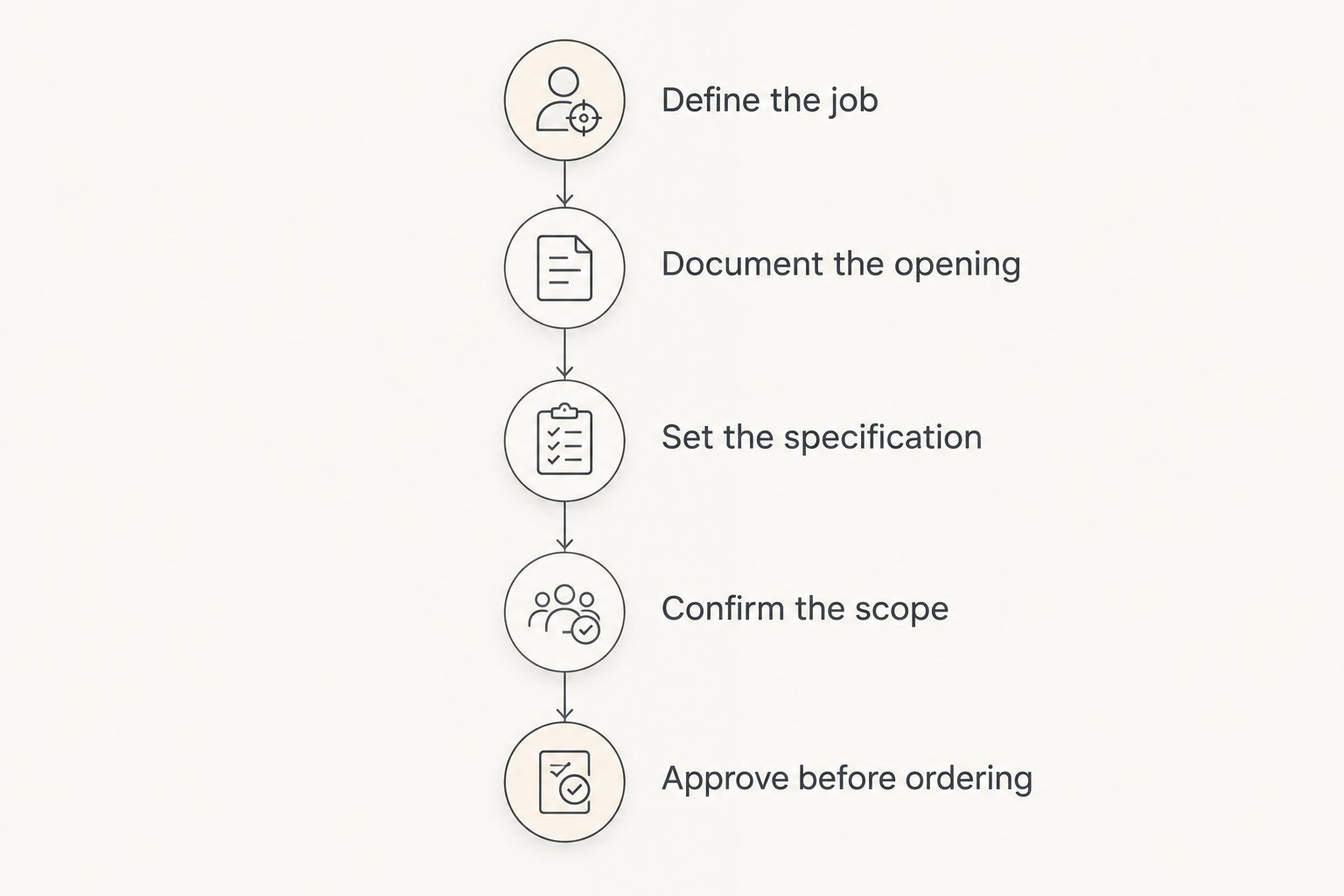
1. Define the job
Write down whether you need privacy, reduced light, decorative framing, or a combination. Explain when you use the room and whether the panels need to move.
A bedroom and a living room can need different treatments even when their windows look similar. Start with use, then select the appearance.
2. Document the opening
Photograph the window straight on and include the surrounding wall, ceiling, trim, and nearby furniture. Record preliminary dimensions in inches, with each measurement clearly labeled.
Keep rough planning measurements separate from approved fabrication dimensions. The window measurements to custom drapery order workflow provides a related planning guide for moving from the opening to an order.
3. Set the specification
Ask the provider to identify the fabric, finished dimensions, heading, lining, hardware, and operating arrangement. Make sure the description says whether the panels are stationary or functioning.
This is also the point to discuss practical concerns: cleaning, access to handles, furniture clearance, and the amount of glass visible when the panels are open.
4. Confirm the scope
Request a written explanation of measuring, fabrication, delivery, installation, and any separately quoted work. Identify who is responsible for each handoff.
A clear scope prevents you from assuming that selecting fabric also includes ordering hardware or arranging installation. Those are separate responsibilities unless your agreement combines them.
5. Approve before ordering
Review the final dimensions and selections together. Ask how changes are handled before approving fabrication, rather than assuming a custom treatment follows the same terms as a ready-made purchase.
For a 2026 renovation, keep the approved brief with your other room selections. It gives you a single reference when discussing the window, furniture, and lighting together.
How do you control the budget without losing the result?
Change the specification deliberately rather than removing necessary parts of the treatment. Hardware that supports daily operation is not interchangeable with a decorative detail you can comfortably simplify.
Ask for alternatives with the differences written down. A revised quote should explain what changed, not simply present a different total.
- Reconsider the fabric: Ask about another fabric suited to the same purpose. Review a sample in the room before deciding.
- Simplify decorative details: Consider whether trims or elaborate headings are essential to the look you want.
- Match construction to use: Choose lining and operation for the room's actual needs. Do not remove privacy coverage from a room that needs it.
- Prioritize rooms: Complete a well-defined treatment in the room that needs it most before committing to every window.
- Check existing hardware: Ask whether it is compatible and suitable before assuming it can stay.
Oakloominteriors offers à la carte interior design, which gives homeowners a service format to ask about when they need help with selected room decisions. Confirm the agreed tasks; do not assume a design appointment includes drapery fabrication or installation.
What should you check before approving the quote?
Read the proposal as an instruction for the finished room. Can you tell what will be installed, how it will operate, and what remains your responsibility?
Before approving a 2026 order, confirm these points:
- The quote identifies the correct room and window.
- Finished dimensions are distinguished from preliminary measurements.
- Fabric, lining, heading, and hardware are specified.
- Stationary or functioning operation is explicit.
- Measuring and installation responsibilities are assigned.
- Separate charges and applicable terms are explained.
If a detail matters to your decision, put it in the written scope. A useful conversation helps you choose; a clear specification tells everyone what has been chosen.
Is custom drapery worth it for an awkward window?
Custom drapery is worth considering when standard dimensions or construction do not meet the window's requirements. Start by identifying the mismatch: fit, coverage, mounting, or operation.
Custom construction does not remove physical constraints. A nearby wall, door handle, or piece of furniture still needs to be considered in the design.
Does a custom drapery quote include installation?
Installation is included only when the written scope says it is included. Ask whether the installation covers hardware mounting, hanging, and any agreed finishing work.
Also confirm who verifies the mounting conditions. An assumption about the wall is not an installation plan.
Can you reuse your existing drapery hardware?
Reuse existing hardware only after confirming compatibility with the proposed treatment. The heading, operating method, mounting arrangement, and fabric load all need to work together.
Keeping a rod you like can be sensible. Keeping incompatible hardware creates a constraint that the new treatment still has to solve.
FAQ
How much does custom drapery cost for my living room?
Custom drapery requires a quote based on your living room's dimensions and treatment specifications. Request a complete scope covering fabric, fabrication, lining, hardware, measuring, and installation so you can compare equivalent proposals.
Is custom drapery better than ready-made curtains?
Custom drapery is better suited to requirements that standard sizes or constructions do not meet. Ready-made curtains remain an option when their dimensions, lining, and operating requirements suit your room.
Do I need lining for custom drapes?
Choose lining according to the treatment's purpose and the fabric's construction. Ask the provider to explain how the proposed lining addresses privacy, light control, appearance, and care.
Can stationary drapery panels give me privacy?
Stationary panels do not provide closing coverage across the window. If you need privacy, include a functioning treatment in the plan rather than relying on decorative side panels.
Should I measure my windows before asking for a quote?
Preliminary measurements and photographs help describe the project. Confirm who takes and approves the final fabrication measurements before placing an order.
What should I bring to an interior design appointment about window treatments?
Bring room photographs, preliminary window dimensions, relevant samples, and a description of your privacy and light-control needs. Oakloominteriors offers interior design services; confirm the appointment's window-treatment scope when arranging support.
Can I order drapery before the renovation is finished?
Approve fabrication only after the dimensions and mounting conditions needed for the order are confirmed. Ask how unfinished trim, flooring, or other room changes affect the final specification.
One last thing
Decide where the open fabric will sit before choosing how the closed drapery will look. Fabric needs somewhere to gather, and that space affects the view, daylight, and nearby furniture.
Stand in the room and picture both positions. A treatment should feel considered when it is open as well as when it is closed—one thoughtful decision at a time.