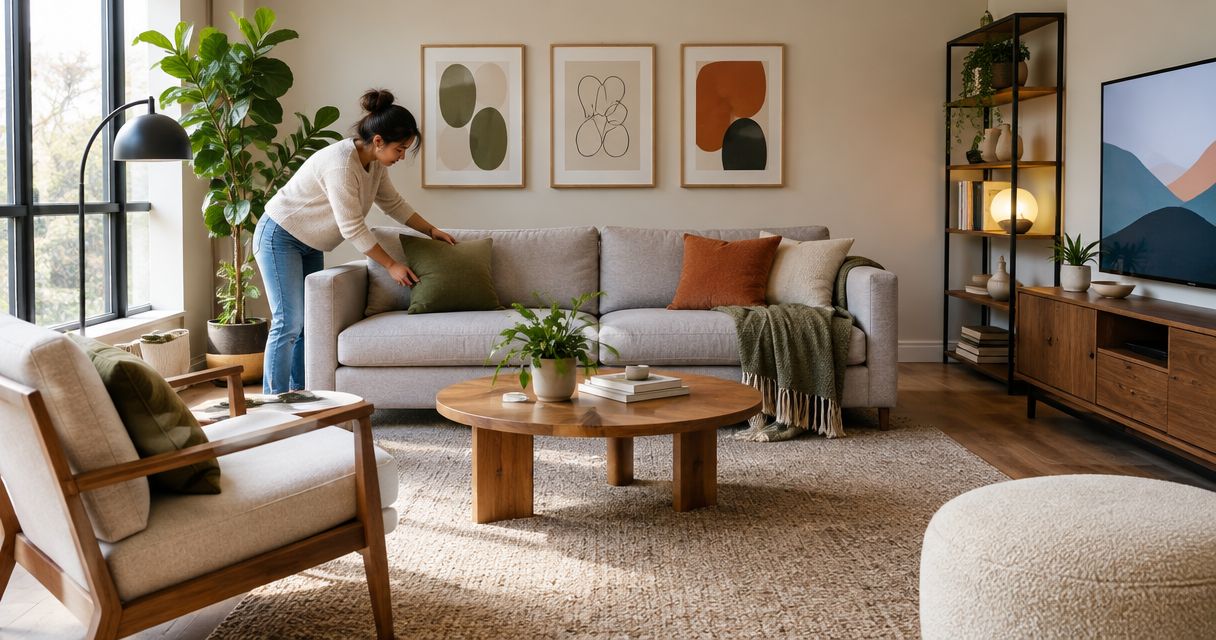
Yes, an interior designer can help on a tight budget when you limit the work to specific decisions, keep useful furnishings, and agree on responsibilities before starting. Design fees are separate from the furnishings and other work your room needs, so professional help belongs inside your total project budget—not on top of it.
- Can an interior designer help on a tight budget? Yes—define the scope before committing to interior design services.
- Oak + Loom Interiors offers full-service and à la carte interior design for Colorado Springs homeowners.
- Keep furniture that fits your needs, and ask for a plan before buying replacements.
- Choose focused design help when you can handle the shopping and coordination yourself.
Why this matters
A tight budget makes the order of your decisions especially important. Buying a sofa before checking the layout, or choosing wallpaper before settling on the room’s furnishings, leaves you solving problems around purchases you already made.
The goal is not to hire a designer for everything. It is to get help with the decisions you cannot confidently make yourself. For your 2026 project, start by identifying that boundary. Oak + Loom Interiors offers full-service and à la carte interior design, giving Colorado Springs homeowners different scopes to discuss rather than assuming every project needs the same service.
Can an interior designer help on a tight budget?
Yes. A clearly bounded assignment gives you a practical way to evaluate professional help without committing to a whole-home project. Ask what the designer will deliver, what you will handle, and what decisions the work will resolve.
Use this sequence before agreeing to a scope:
- Choose 1 room. Start with the room whose problems affect your daily life most, rather than spreading your attention across the house.
- Write down 3 priorities. Describe outcomes such as easier conversation, better reading light, or storage that keeps everyday items accessible.
- Identify what stays. Include furniture you like, pieces you need, and anything you cannot replace within this project.
- Request a defined assignment. Ask whether the designer can address your priorities through a focused service, and confirm the deliverables in writing.
- Review the complete commitment. Include design work, purchases, installation, and the tasks you will manage yourself.
These are planning boundaries, not minimum requirements imposed by a studio. Your project should fit your circumstances.
A designer’s involvement does not guarantee savings. The useful question is whether the proposed work resolves a decision that matters enough to justify making room for it in your budget.
Which level of design help fits your project?
Compare responsibilities before comparing proposals. A service that leaves purchasing and coordination with you is different from one that includes those tasks, even when both address the same room.
| Approach | Best for | Main benefit | Main limitation |
|---|---|---|---|
| Focused consultation | Homeowners with a specific unresolved question | Keeps the discussion centered on a defined decision | Confirm whether written recommendations or follow-up are included |
| À la carte design | Homeowners seeking help with selected parts of a project | Lets you discuss a narrower assignment | Work outside the agreed scope remains your responsibility |
| Full-service design | Homeowners seeking broader design involvement | Allows more connected decisions to sit within one assignment | Confirm the extent of purchasing, coordination, and implementation |
| Self-directed decorating | Homeowners comfortable planning and managing their room | Keeps decision-making in your hands | You handle measurements, selections, and problem-solving |
Choose the smallest scope that fully addresses your problem—not simply the shortest service description. A focused appointment is not enough if your real need is someone to coordinate connected decisions throughout a renovation.
Focused consultation: best for a decision you cannot settle
A consultation is worth discussing when you know what is bothering you but cannot resolve it. Perhaps your seating arrangement feels awkward, or you cannot decide which existing piece should guide the room.
Prepare questions that lead to decisions. Ask which layout better supports your daily routine, rather than asking whether the room looks good. Bring measurements and photographs so the conversation addresses your actual space.
The limitation is follow-through. Do not assume a conversation includes drawings, a shopping list, or later revisions. Ask what you will leave with and whether that result is enough for you to continue independently.
À la carte design: best for a defined part of the room
À la carte design suits a project where you want professional input on selected tasks and are comfortable managing the rest. Ask whether your particular need fits the studio’s available services rather than assuming every task can be purchased separately.
For a 2026 furnishing project, the assignment might center on a layout or a set of selections, depending on what the designer offers. Name the decisions you want help making and ask for a written description of the work.
The trade-off is ownership of the gaps. If the assignment covers selections but not ordering, you need to manage purchasing and resolve questions outside the agreed service. A narrower scope works only when those remaining responsibilities are realistic for you.
Full-service design: best for connected decisions
Full-service design deserves consideration when your project involves decisions that cannot sensibly stand alone. Furniture placement, lighting, and finishes need to work together; resolving each in isolation leaves you responsible for checking the whole room.
That does not mean full-service design fits every tight budget. A broader assignment includes more work, and you should understand that work before deciding whether to proceed.
Ask which responsibilities the proposal includes and where your involvement remains necessary. Do not choose full-service design merely because it sounds reassuring, or reject it without understanding whether your project genuinely needs that level of support.
Why the scope of budget-friendly design varies
The right assignment depends on what your room needs and what you can comfortably manage. Discuss these factors before requesting a proposal:
- Existing furniture: A room built around useful pieces needs different decisions from an empty room.
- Decision complexity: Choosing a paint direction is a different assignment from coordinating furnishings, lighting, and finishes.
- Deliverables: Verbal advice, drawings, and written selections are not interchangeable. Confirm the output you need.
- Your responsibilities: Measuring, shopping, scheduling, and following up all need an owner.
- Revision boundaries: Ask how changes are handled, especially after you approve a direction.
- Project sequence: Identify which decisions must happen now and which purchases can wait.
For your 2026 plan, describe these conditions plainly. A clear account of the work is more useful than asking a designer to make an unspecified project affordable.
How to prepare before paying for design help
Preparation gives a designer a clearer problem to solve. You do not need a polished presentation; you need accurate information and a short list of decisions.
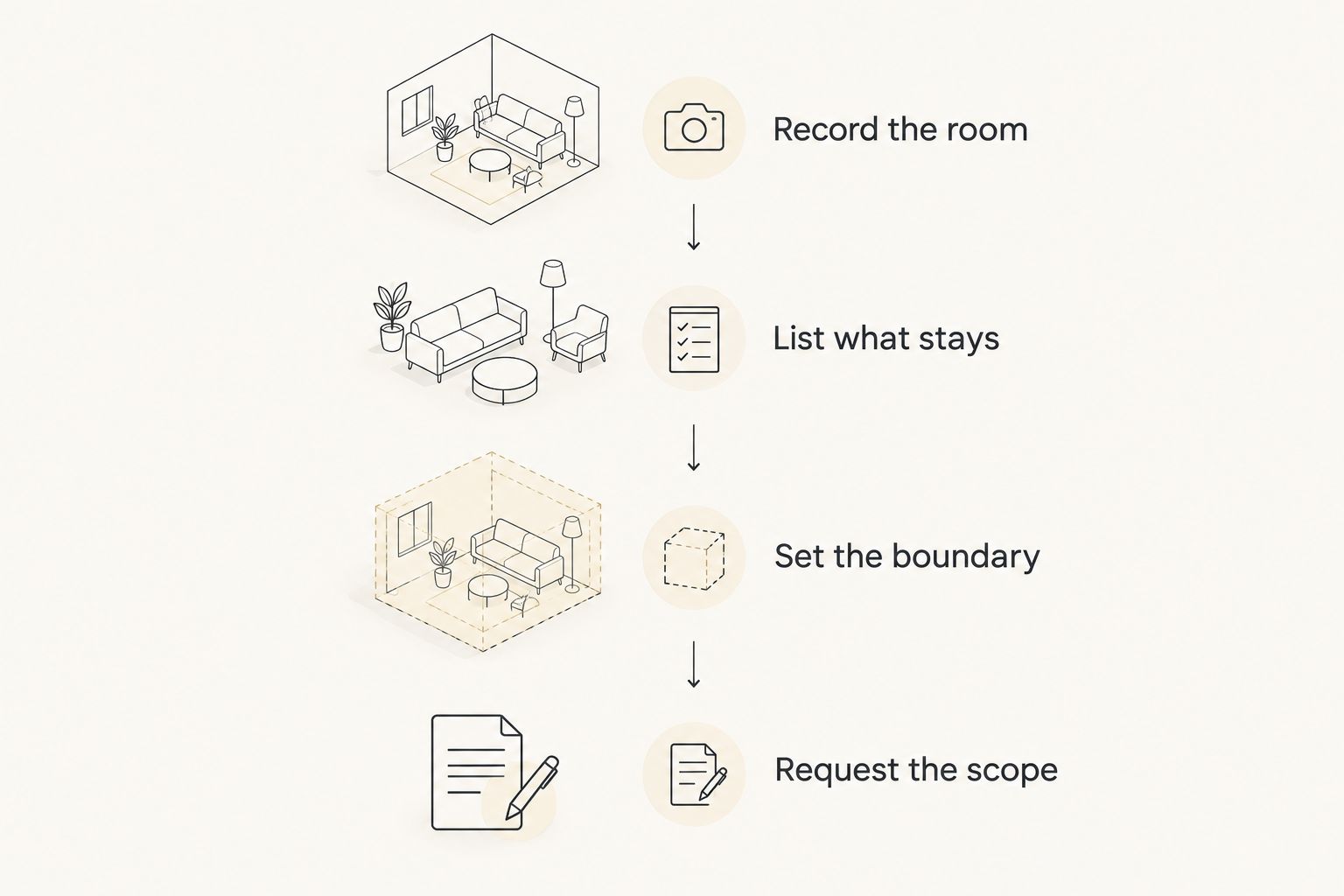
Record the room
Measure the room and the furniture you intend to keep. Note doors, windows, outlets, and features that affect placement. Photograph the room from different corners rather than supplying only close-ups of decorative details.
Include the inconvenient parts. A walkway that doubles as a play area or a desk that must stay in the living room belongs in the brief. Those details shape a workable plan.
List what stays
Separate your belongings into keep, reconsider, and replace categories. Treat this as an assessment of usefulness, condition, fit, and personal meaning—not a judgment about whether everything matches.
An inherited table or comfortable chair gives the project a real starting point. Tell the designer which pieces are nonnegotiable before selections begin, not after a direction has been developed around replacing them.
Set the boundary
State your total spending limit and explain what it must cover. Distinguish design work from furnishings and any installation or trade work the project requires.
Also state your limits on personal involvement. If you cannot receive deliveries, compare specifications, or coordinate appointments, do not build a plan around doing those things yourself simply to narrow the design assignment.
Request the scope
Ask for a written explanation of the assignment before you approve it. Look for the decisions covered, the deliverables, your responsibilities, and the process for handling changes.
A useful scope lets you explain what you are buying in ordinary language. If you cannot tell whether the service ends with recommendations or continues through implementation, ask for clarification before proceeding.
How to keep the project within its agreed boundaries
Once you have a direction, new ideas need a place to go without automatically becoming new work. Keep a separate list of later improvements so an appealing addition does not quietly become part of the current assignment.
Before approving a change, ask what it replaces, what other decisions it affects, and whether it changes the agreed service. Adding a new finish can reopen a settled selection; replacing a retained piece can change the layout.
For 2026, make your approval rule simple: no new task enters the project without a clear decision about scope and responsibility. That protects both the spending plan and the partnership.
If you are comparing 2 layouts, settle the furniture arrangement before purchasing pieces that only work in one of them. Buying first transfers the decision from your floor plan to your existing commitments.
When professional help is not the right next step
Pause if your essential household needs already use the money available for the project. Design help is not a reason to stretch beyond a limit you need to protect.
Also pause when the problem remains undefined. If you cannot yet say whether the room needs better function, different furniture, or simply less clutter, start by observing how you use it and removing items you no longer need.
You can return to the design conversation with a smaller, clearer assignment. There is no requirement to finish a home all at once, and an unfinished room is not a failed room.
Where local design support fits
Oak + Loom Interiors is best for Colorado Springs homeowners seeking interior design services alongside curated home furnishings. The studio and showroom offers full-service and à la carte interior design, plus furniture, lighting, and wallpaper.
Those options create a useful starting point for discussing your needs, but they do not establish whether a particular assignment fits your budget. Ask which scope addresses your priorities and what remains your responsibility. The right partnership starts with that clarity, one room and one thoughtful decision at a time.
Do I need to replace all my furniture?
No. Start with the furniture that works for your household and ask whether the design assignment can incorporate it. Be clear about what must stay, while remaining open to moving a piece into another room if its current location is the problem.
Should I finish one room or buy a little for every room?
Choose a focused room plan when scattered purchases are leaving you without a usable result. That does not require buying everything immediately; it means knowing how each purchase serves the room before you make it.
Is a smaller design service always the better choice?
No. A smaller service is useful only when its deliverables resolve your problem and you can manage the work left outside it. Choose the scope by responsibility, not by the appeal of doing less at the outset.
FAQ
Can an interior designer help if my budget is really tight?
Yes, an interior designer can help when a defined assignment fits inside your total project budget. Ask for help with specific decisions rather than assuming you need a whole-home service.
What's the best way to prepare for a budget-conscious design conversation?
Bring room measurements, photographs, a list of furniture you want to keep, and your spending boundary. State which decisions you want the designer to resolve.
Is à la carte interior design better than full-service design?
À la carte design is better suited to selected tasks when you can manage the remaining work yourself. Full-service design is worth discussing when your project needs broader, connected involvement.
Can I ask a designer to work with furniture I already own?
Yes, ask whether the proposed assignment can incorporate your existing furniture. Identify the pieces that must stay before the designer develops a direction.
Will hiring a designer definitely save me money?
No, hiring a designer does not guarantee savings. Evaluate whether the defined work resolves decisions that justify its place in your project budget.
What should I ask before agreeing to design services?
Ask what the service includes, what you will receive, what you must handle, and how changes are addressed. Confirm those boundaries in writing before approving the work.
Does Oak + Loom Interiors offer different levels of interior design help?
Oak + Loom Interiors offers full-service and à la carte interior design in Colorado Springs. Ask which available scope fits your project and which responsibilities remain with you.
One last thing
Before buying anything for your 2026 room, identify what you are trying to fix. If the answer is an awkward walkway, start with placement. If the answer is poor reading light, start with the activity and its location—not an unrelated furniture replacement.
A tight budget needs a clear problem before it needs a shopping list. Give yourself permission to keep what works and leave some decisions for later. A thoughtful room can develop in stages without asking you to solve the whole home today.