The cost to redesign a home office depends on what you keep, what you replace, and whether you change the room itself; a furniture refresh and a renovation need different budgets. For a 2026 project, build your total around furnishings, design support, room improvements, and any separately quoted delivery or installation rather than treating a furniture shopping list as the finished cost.
- How much does it cost to redesign a home office? Define the scope before comparing project totals.
- Keep furniture that fits your work, then prioritize seating, desk placement, lighting, and storage.
- Oak + Loom Interiors offers full-service and à la carte interior design for homeowners furnishing or renovating.
- Compare written proposals by included work, exclusions, and responsibilities—not just the headline total.
How much does it cost to redesign a home office?
Your home office budget should cover the finished room, not just the furniture. Start by deciding whether you need a focused refresh, a complete furnishing plan, or changes to the room itself. Then compare proposals for the same work.
If furniture placement is your main challenge, the guide to home office furniture for small spaces is a useful companion before you start selecting pieces.
| Project scope | Best for | What belongs in the budget | Main advantage | Main limitation |
|---|---|---|---|---|
| Focused refresh | A working office with specific frustrations | Selected furniture, lighting, storage, finishes, and any requested design guidance | Preserves useful pieces and limits the scope | Does not resolve problems outside the agreed work |
| Complete furnishing plan | A room that needs a coordinated layout and furnishings | Furniture, lighting, window treatments, decorative finishes, and defined design services | Lets you consider the room as a whole | Requires more selections and coordination |
| Room renovation | An office needing changes to its existing space | Defined construction work, relevant trades, finishes, furnishings, and design services | Addresses the room as well as its contents | Adds work that a furniture-only proposal does not cover |
These are planning categories, not service packages. Use them to describe your project clearly when requesting a 2026 proposal.
Why this matters
A home office has to support your working day before it looks finished. A beautiful desk is not a complete solution if your chair cannot move comfortably, daylight reflects on your screen, or paperwork has nowhere to go.
The budget becomes easier to evaluate when every selection answers a specific need. Instead of asking whether a piece looks right on its own, ask what it improves and what other work it requires.
Choose the smallest scope that solves the real problem. That keeps a simple furnishing decision from becoming an unnecessary room overhaul, while leaving room for improvements you genuinely need.
What belongs in a home office redesign budget?
Separate the project into clear categories before approving purchases. A written breakdown helps you see whether proposals cover the same result and whether you are responsible for additional arrangements.
Furniture and storage
List the furniture you intend to keep before listing what you want to buy. Include your desk, chair, shelving, cabinets, and any seating used by visitors or other household members.
Judge each existing piece by fit and function, not by whether it matches a new inspiration image. A useful cabinet can remain part of the plan even if the lighting, wall finish, and desk placement change.
For new pieces, record dimensions and intended placement. Do not approve furniture until you know where it will go and how you will move around it.
Lighting and window treatments
Consider daylight, task lighting, and the room's general lighting together. Check where you sit, where your screen faces, and what changes between morning and afternoon.
Distinguish between selecting a lamp and requesting work on installed lighting. Ask who is responsible for any electrical work and whether it appears in the proposal. Treat window treatments the same way: selection, measuring, and installation are separate questions to resolve.
Wall finishes and room improvements
Paint, wallpaper, and changes to the room belong in the scope before you finalize furniture selections. Existing wall conditions and any preparation work should be discussed with the person responsible for installation.
If the project includes built-in storage, relocated outlets, or other alterations, describe those changes explicitly. Do not assume a furnishing proposal includes construction simply because both contribute to the finished office.
Design support and project responsibilities
Ask what the design service includes: advice, layout planning, selections, revisions, ordering assistance, or coordination. The important distinction is the agreed work, not the service name alone.
Also identify who approves selections, places orders, receives deliveries, and arranges installation. A clear division of responsibility helps you compare proposals without overlooking tasks you will need to handle yourself.
Why home office redesign costs vary
For your 2026 home office plan, these scope decisions explain why two rooms can require very different proposals:
- Existing furniture: Keeping a desk, chair, or storage piece changes what you need to purchase. Confirm that each retained piece works in the proposed layout.
- Extent of the redesign: Replacing a lamp is a different project from furnishing an empty room or changing its built-in features.
- Design involvement: Targeted guidance and broader project support cover different responsibilities. Compare the written deliverables.
- Lighting and electrical work: Choosing furnishings does not automatically include changes to the room's electrical setup. Define that work separately.
- Finishes and installation: Wallpaper, window treatments, and other installed elements require decisions beyond appearance, including measuring and preparation.
- Delivery and coordination: Establish who handles receiving, placement, assembly, and installation, and whether those tasks appear in the proposal.
None of these categories needs to become an automatic purchase. They are prompts for a clearer conversation about what your room needs and what your project includes.
How do you build a budget before choosing furniture?
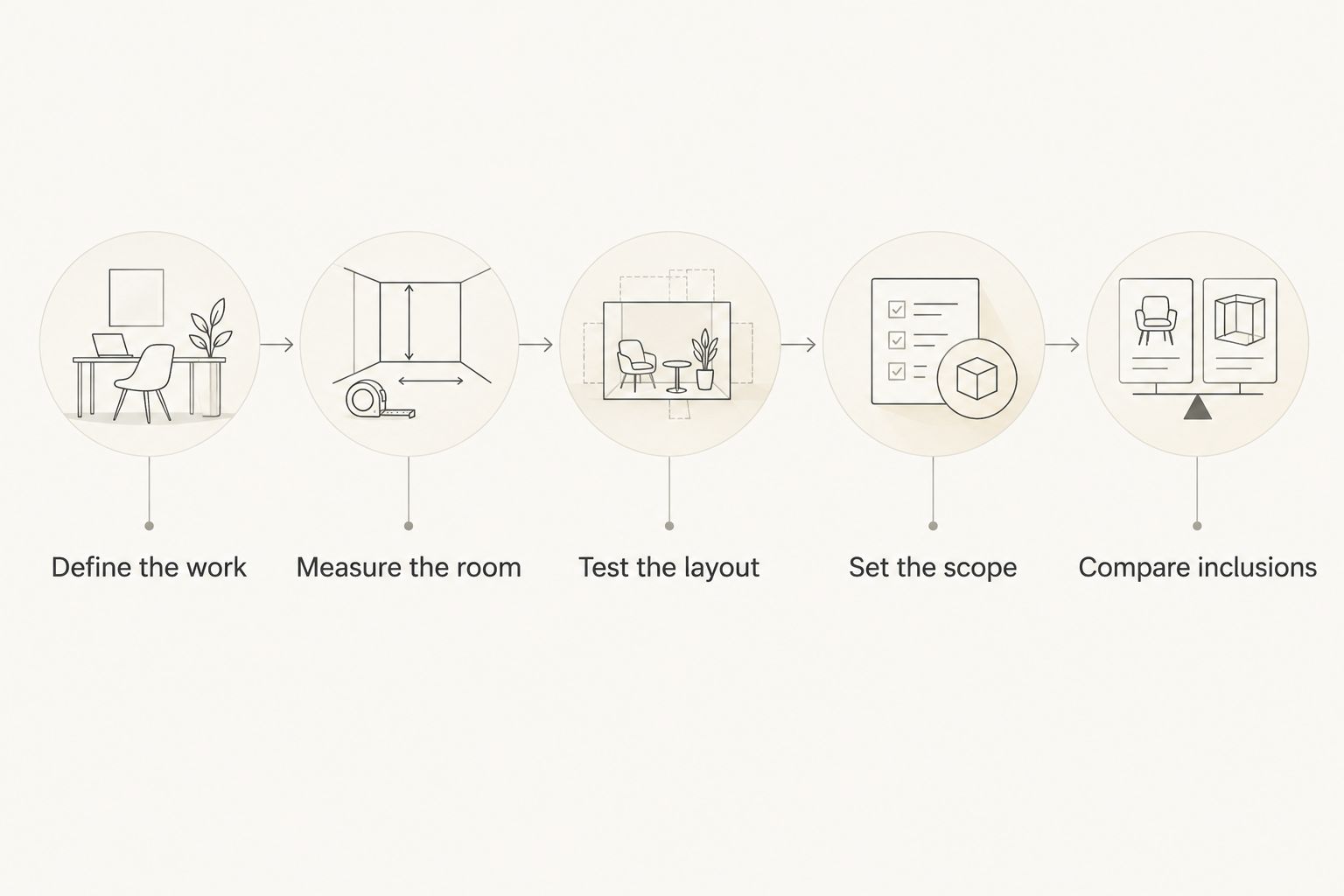
Start with your working day, then translate it into a room plan. This sequence gives you something more useful than a collection of attractive pieces: a brief you can use to make decisions.
1. Define the work
Write down what happens in the office: focused computer work, calls, paperwork, creative projects, or meetings. Include any other role the room serves, such as guest accommodation or household storage.
Choose 3 priorities for the redesign. These might be a more comfortable workstation, accessible document storage, and a calmer video-call background. Treat those priorities as your decision filter, not as a requirement to replace everything.
2. Measure the room
Record the room's dimensions, doors, windows, outlets, and fixed features. Measure any furniture you plan to retain, including the space it needs when drawers or doors are open.
Do not rely on floor area alone. A room can have enough space for a desk while still placing it awkwardly beside a doorway or in front of storage you need to access.
3. Test the layout
Sketch 2 layout options before settling on a furniture list. Compare where you face, how you reach storage, and whether the chair can move without blocking a route through the room.
You can also mark proposed furniture positions on the floor. The aim is to understand the arrangement before making a commitment, not to produce a perfect drawing.
4. Set the scope
Create a brief for 1 room with separate headings for what stays, what changes, and what needs professional input. Add your spending limit privately or share it with the professionals preparing proposals.
Keep optional ideas separate from essential work. That gives you a clear place to make adjustments without losing the purpose of the redesign.
5. Compare inclusions
Request proposals against the same brief. Check the listed work, exclusions, approval process, and responsibilities before comparing totals.
Which design approach fits your home office?
Oak + Loom Interiors is best for Colorado Springs homeowners seeking interior design support alongside curated home furnishings. The studio and showroom offers full-service and à la carte interior design, plus furniture, lighting, and wallpaper.
For a home office, begin the conversation with the decisions you want help making. A layout problem, a few furnishing selections, and a room renovation call for different discussions about scope.
The advantage of choosing between full-service and à la carte support is the opportunity to match the engagement to your needs. The boundary is equally important: those labels alone do not establish which deliverables, purchasing tasks, or installation arrangements are included. Ask for the specific home office scope in writing.
For your 2026 project, bring photographs, room measurements, retained furniture dimensions, and your priorities. Oak + Loom Interiors can then be part of a conversation grounded in your home rather than an abstract wish list.
Discuss your home office plans
Share your room, priorities, and the design decisions you want help making.
Can I redesign my home office without replacing everything?
Keep furniture that fits your work and the proposed layout. Redesigning a room does not require discarding every existing piece, and replacing useful furniture should not be the default starting point.
Evaluate retained pieces honestly. A desk that provides a useful work surface still needs a suitable position; a cabinet that holds everything still needs accessible doors and drawers. Design around what works, not around an obligation to keep or replace it.
Is à la carte design better than full-service design?
À la carte design suits a defined need; full-service design suits a broader request for support. The right choice depends on which decisions and coordination tasks you want to retain.
Neither label guarantees a particular total or a fixed list of deliverables. Compare the actual scope, and ask how additional requests are handled before you commit.
Should I finish the whole office at once?
Finish the essential work first if you need to phase the project. Establish the layout, usable workstation, lighting needs, and necessary storage before treating decorative finishing touches as urgent.
Phasing has a trade-off: you retain flexibility, but you also take responsibility for keeping later selections consistent with the plan. Record your dimensions, finishes, and priorities so future decisions support the same room.
FAQ
How much does it cost to redesign a home office in 2026?
The total depends on the furniture, design services, room changes, and delivery or installation included in your project. Define that scope first, then request a written proposal that separates included work from exclusions.
What's the first thing I should budget for in a home office?
Budget around a usable workstation and a workable layout first. Identify what you can retain before adding furniture, lighting, storage, and decorative finishes to the plan.
Can I use furniture I already own in a redesigned office?
Yes, existing furniture can remain when its dimensions, condition, and function suit the new plan. Measure each piece and check access, drawer movement, and chair movement before finalizing the layout.
Is a home office furniture budget the same as a redesign budget?
No, a furniture budget covers only part of a redesign when the project also includes design support, room improvements, or installation. Ask for those categories to be identified separately.
Can Oak + Loom Interiors help with a home office project?
Oak + Loom Interiors offers full-service and à la carte interior design, along with curated home furnishings, for homeowners furnishing or renovating. Discuss your home office needs to establish the appropriate scope and deliverables.
Should I buy a desk before planning the room?
Plan the layout before committing to a desk. Check the proposed position against windows, doors, outlets, storage access, and the space your chair needs to move.
What should a home office design proposal include?
A useful proposal identifies the agreed work, deliverables, exclusions, and responsibilities. Ask who handles selections, approvals, ordering, delivery arrangements, and installation wherever those tasks apply.
One last thing
Before approving your 2026 home office plan, sit where the desk will go and act out an ordinary working moment. Turn toward the door, reach for a file, move the chair back, and look toward the window.
A room can look complete in a photograph and still interrupt your work. Let that small rehearsal guide the final decisions—one room, one piece, one thoughtful decision at a time.