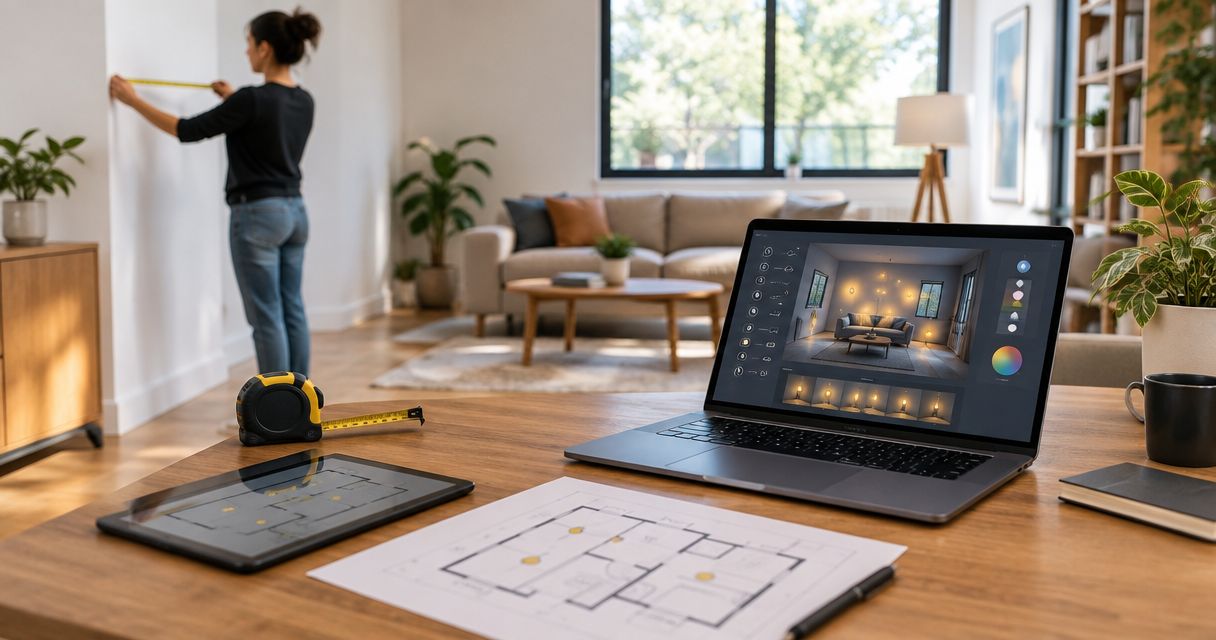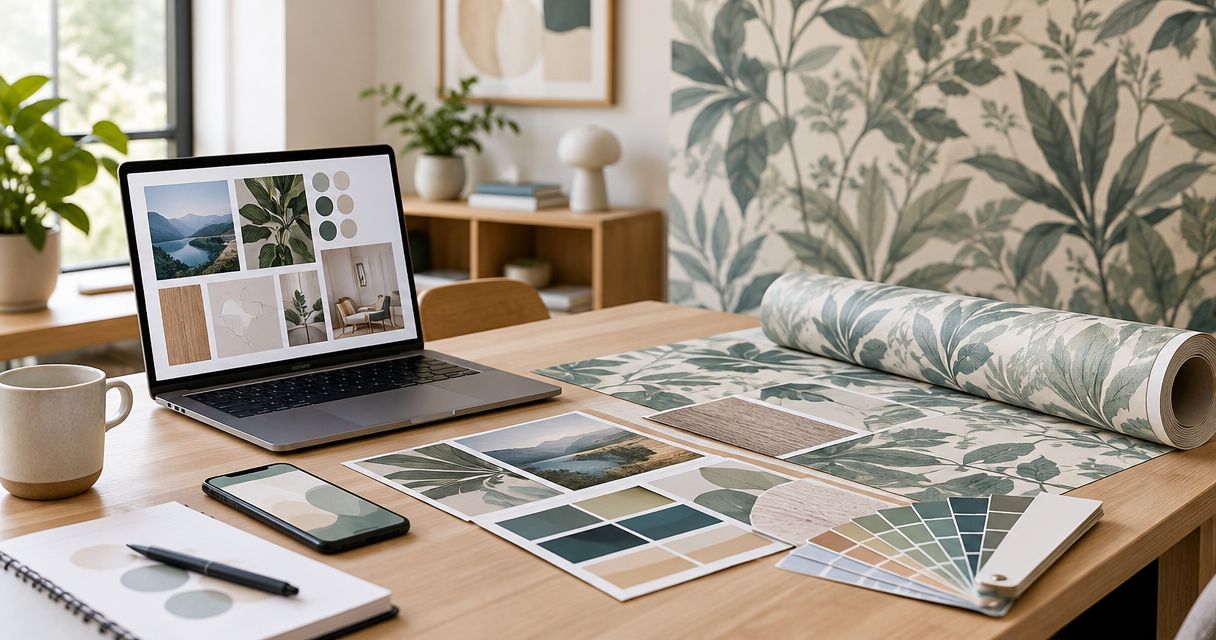
Instead of juggling saved images, sample requests, and wall measurements, use a mood board to custom wallpaper order workflow that turns inspiration into a checked specification before you order. This 2026 guide takes you from room references to physical samples, installer-confirmed measurements, and a final supplier proof.
- Oak + Loom Interiors suits homeowners seeking interior design guidance that connects wallpaper with the rest of the room.
- A mood board to custom wallpaper order workflow needs physical samples, verified measurements, and written approval.
- Confirm pattern scale and wall preparation before approving custom wallpaper artwork or quantities.
- Keep one current specification so your designer, supplier, and installer work from the same decisions.
Why this matters
A mood board communicates a feeling; an order specification communicates what someone must supply. Confusing the two leaves decisions about scale, material, placement, and installation unresolved.
Oak + Loom Interiors is best for Colorado Springs homeowners seeking interior design guidance that connects wallpaper with the whole room. The studio offers full-service and à la carte interior design alongside curated home furnishings. Start with Oak + Loom Interiors if you want help connecting wallpaper choices with furniture and lighting; confirm the scope of wallpaper sourcing and ordering directly.
Design guidance helps coordinate choices, but it does not replace a supplier's production requirements or an installer's site assessment. Keep those responsibilities separate throughout your 2026 project.
Before you start
- Gather room materials: Collect your inspiration images, existing finish samples, room photographs, and access to every wall receiving wallpaper. Include furniture and lighting you intend to keep.
- Identify decision-makers: Decide who approves the design, who confirms quantities, and who places the order. Establish contact with the intended supplier and installer before treating measurements as final.
- Check the hidden constraint: Ask whether the proposed wallcovering suits the wall surface and room conditions. A compelling sample is not approval to install it over an unsuitable substrate.
Also clarify what “custom” means for your project. Made-to-measure artwork, an altered colorway, and a standard repeating pattern ordered for a specific room require different approvals. Do not assume the supplier offers every form of customization.
Room brief and mood board
Turn inspiration into a usable brief
Use a shared document or folder rather than scattering decisions across messages. The bold labels below are suggested document fields, not buttons or settings in a particular app.
- Create a Room brief with the room name, intended use, retained furnishings, and the feeling you want. Describe the actual space rather than copying a style label.
- Add Keep, Change, and Avoid fields. Separate fixed elements, such as flooring, from choices still open for discussion.
- Take at least 3 room photographs: a straight-on wall view, a corner view, and a wider view showing adjacent finishes. Add more wherever a doorway or obstruction needs explanation.
- Build a Wallpaper direction section with references for color, motif, texture, and scale. Label what attracts you in each image; otherwise, someone else has to guess.
- Assign a Decision owner and record an Approval date. Keep one current brief rather than several competing versions.
For a 2026 renovation, distinguish existing finishes from finishes that are only proposed. A wallpaper chosen to match an unapproved cabinet sample is still a provisional choice.
Expected result: You have a room-specific brief that explains the desired effect and the constraints a wallpaper selection must respect.
Choose the wallpaper format
Discuss the format before refining artwork. A repeating pattern and a made-to-measure mural solve different design problems, and neither is automatically the better choice.
| Wallpaper format | Best for | Main advantage | Main limitation | Approval priority |
|---|---|---|---|---|
| Repeating pattern | A continuous patterned treatment across walls | The motif continues through the installation | Pattern matching affects layout and material requirements | Repeat, match, usable coverage, and starting position |
| Made-to-measure mural | A composition placed on a specific wall | Artwork can be arranged around that wall's features | Changes to dimensions or cropping affect the composition | Wall dimensions, crop, panel sequence, and focal placement |
Choose the format for the wall, not just the saved image. If you need visual direction first, use the wallpaper trends guide to refine your vocabulary, then return to the room brief.
Sample review and material approval
Check the design in the room
- Request the supplier's available physical sample and the relevant material information. Ask what the sample does and does not represent, especially for custom artwork or altered colors.
- Create a Sample review field covering color, texture, sheen, and motif scale. Keep the supplier's material reference beside the sample so similar-looking options do not get confused.
- Review the sample in at least 2 lighting conditions: daylight and the artificial lighting you normally use. Place it beside the actual paint, upholstery, flooring, and trim.
- Mark Approved, Revise, or Rejected, with a short reason. If scale is unclear, request an appropriate scale reference before approval.
- Ask the installer to review the material's installation instructions and wall preparation requirements. Resolve suitability before moving to final quantities.
A sample shows more than color. Surface texture and reflected light can change how a wallcovering sits alongside matte paint, polished stone, or woven upholstery.
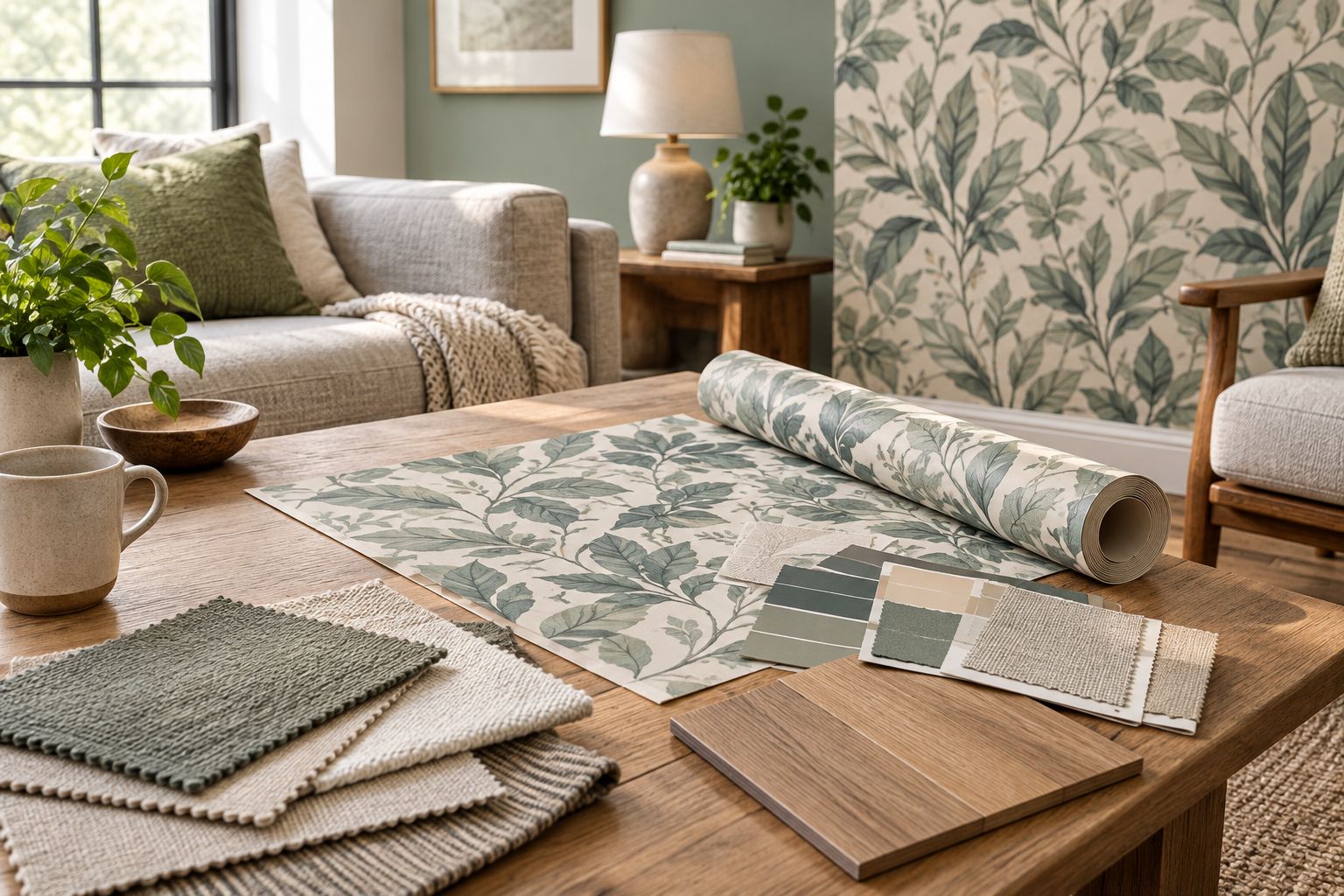
Do not approve a whole-wall composition from a small material swatch alone. For a mural, distinguish approval of the surface and color from approval of the artwork's final placement.
Expected result: Your selected material and design direction have written approval, with unresolved questions clearly recorded rather than silently carried into ordering.
Wall survey and order specification
Record the wall information
- Create a Wall schedule and give each wall an unambiguous name, such as entry wall or window wall. Match those names to photographs and sketches.
- Record width and height in the units requested by the supplier. Show measurement points on the sketch, including changes in height, slopes, recesses, and returns.
- Record doors, windows, outlets, switches, built-ins, and other interruptions. For a mural, note which features could cover or divide an important part of the image.
- Ask the installer to verify the measurements and proposed layout. Do not subtract openings or calculate an allowance without checking the supplier's and installer's requirements.
- Complete Material reference, Pattern repeat, Pattern match, and Installation instructions using supplier information. For a mural, include Artwork orientation, Crop, and Panel sequence instead of assuming repeating-pattern rules apply.
Do not turn wall area alone into an order quantity. Pattern matching, usable material dimensions, wall geometry, and the intended layout all affect the specification.
Keep one measurement system throughout the 2026 order file. If a supplier needs a conversion, show both the original measurement and the confirmed converted value rather than overwriting the source.
Expected result: The supplier receives a traceable wall schedule, and the installer has checked the assumptions behind the proposed order.
Assemble the approval packet
Keep the approved brief, sample reference, wall schedule, and supplier proof together. Use these exact document labels consistently: Room brief, Sample approval, Wall schedule, and Supplier proof.
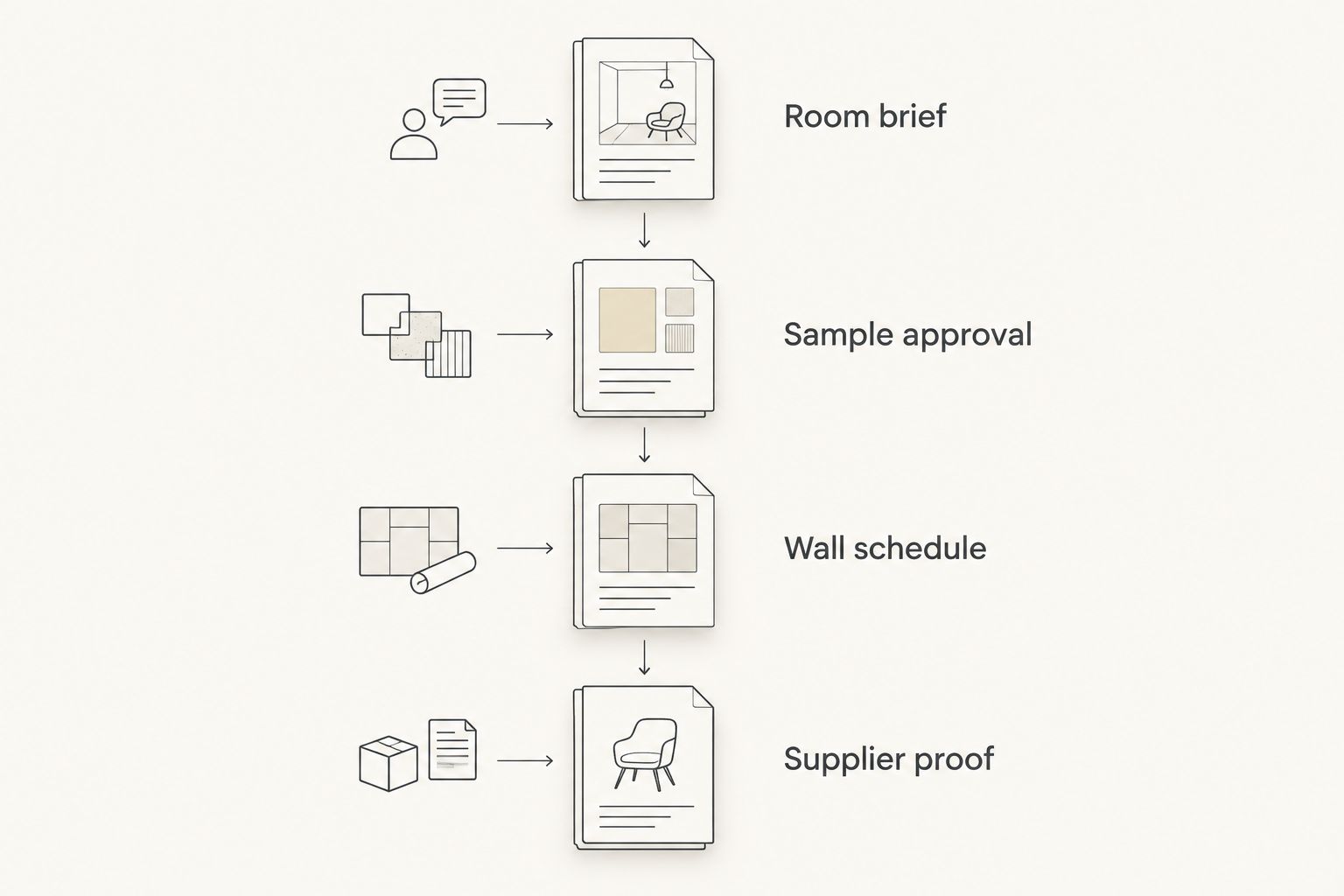
A complete packet makes review easier, but it cannot correct an inaccurate measurement. Ask each participant to confirm the part they are responsible for rather than requesting a vague approval of everything.
Final proof and order release
Approve the specification before ordering
- Request the supplier's final written specification and any artwork proof relevant to the order. Compare them with the approved packet, not with memory or an older message.
- Check the material reference, color reference, dimensions, orientation, and quantity. For murals, inspect cropping, focal placement, and the panel layout around architectural features.
- Record Final approval only when the named decision-maker has accepted the current version. Keep design approval separate from measurement confirmation.
- Confirm who places the order and who receives the supplier's acknowledgment. Save that acknowledgment beside the approved specification and check for discrepancies immediately.
- Share the confirmed documents with the installer. At receipt, check identifying information and inspect the material according to supplier guidance before cutting or installation begins.
For your 2026 approval record, use a date and a descriptive version name. “Final” is not useful when several attachments carry the same filename.
Expected result: The approved specification, supplier acknowledgment, and installation documents describe the same wallpaper treatment. You have a clear record of what was authorized and by whom.
When the mood board changes after approval
A revised paint color or furniture choice does not automatically require new wallpaper. It does require a controlled review rather than a silent substitution.
- Mark the affected decision Under review and identify whether the change concerns appearance, dimensions, material, or installation.
- Update only the affected documents. A color change calls for renewed sample review; a moved doorway calls for a revised wall schedule and artwork check.
- Ask the supplier about the order's current status before authorizing revisions. Do not assume an approved or placed order can be changed.
- Collect fresh approval for the revised version and clearly retire superseded files.
Keep approved decisions stable unless a change solves a real room problem. This protects the relationship between wallpaper, furnishings, and architecture without treating your original mood board as untouchable.
Troubleshooting
The sample looks different from the screen
Judge the physical sample under the room's lighting, then check whether it represents the intended material and colorway. Screens are not a substitute for material approval. Ask for clarification before authorizing production if the sample and artwork reference appear inconsistent.
The motif looks wrong at full scale
Pause approval and request a clearer scale reference or wall-specific proof. A cropped inspiration photograph does not establish repeat size. Check the design from the room's usual viewing positions, especially where furniture conceals part of the wall.
Measurements disagree
Return to the labeled wall sketch and have the installer verify the disputed dimensions. Check units and measurement points first. Do not average conflicting figures; establish which measurement describes the actual installation surface.
The proof places artwork behind an obstruction
Mark the obstruction on the wall schedule and request a revised crop or layout. Review the entire composition again, not just the corrected area. Moving a focal element can change what appears at an edge or across a corner.
The wall is not ready for installation
Stop and have the installer assess the substrate against the wallcovering manufacturer's instructions. Resolve moisture, unstable finishes, or surface defects before installation. Wallpaper selection and wall preparation are separate approvals; completing one does not complete the other.
Customize your workflow
Expand the brief to include adjacent spaces when wallpaper is visible through an open doorway. Record the neighboring paint, lighting, and major furniture finishes so the transition feels intentional rather than accidental.
Oak + Loom Interiors offers full-service and à la carte interior design, making the studio a relevant starting point when you want help coordinating these room decisions. Confirm the responsibilities for sampling, measuring, supplier communication, and ordering before engaging support. The benefit is coordinated design guidance; the boundary is that specialist production and installation checks still need clear ownership.
Plan your wallpaper project
Explore interior design support for coordinating wallpaper with your room's furniture and lighting.
FAQ
What's the best mood board to custom wallpaper order workflow?
Start with a room brief, approve physical samples, verify wall measurements, and approve the supplier's final specification before ordering. Keep those decisions in one current file with a named approval owner.
Can I order custom wallpaper from a mood board alone?
A mood board alone is not an order specification. The supplier also needs the relevant material, artwork, measurement, and layout information for the wallpaper you select.
Should I choose a repeating wallpaper or a custom mural?
Choose a repeating pattern for a continuous motif and a mural for a wall-specific composition. Repeating patterns require attention to matching; murals require close review of cropping and focal placement.
Do I need an installer before ordering wallpaper?
Involve the intended installer before finalizing measurements and quantities. The installer can check wall conditions, layout assumptions, and preparation requirements against the selected material's instructions.
Can I use a digital proof instead of a physical sample?
A digital proof does not replace a physical material sample. Use the proof to review artwork and placement, and the sample to assess color, texture, and finish in the room.
What should I do if my wall dimensions change?
Recheck the wall schedule and ask the supplier to review the affected specification before proceeding. For a mural, revised dimensions also require a fresh check of cropping and panel layout.
Can Oak + Loom Interiors help me coordinate wallpaper with furniture?
Oak + Loom Interiors offers interior design services and curated furnishings, including wallpaper, furniture, and lighting. Ask the studio to confirm the scope of support for your specific wallpaper project.
One last thing
Approve what the room will show, not only what the artwork contains. Before releasing your 2026 order, put the intended furniture positions on the wall sketch. A favorite part of a mural has little value if a headboard or cabinet hides it.